Showing posts with label pink. Show all posts

Monday, 19 June 2017

New Design Release - Pink Mulla Mulla

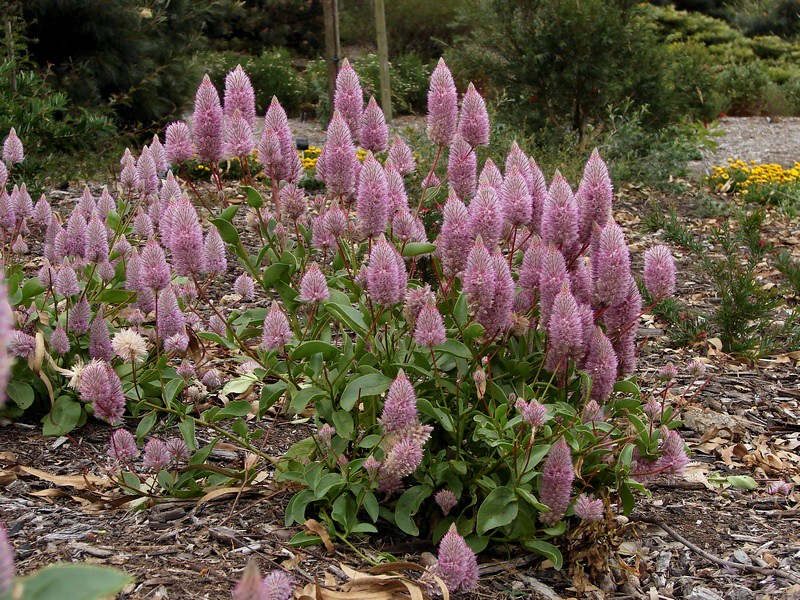
So very pleased to release a new design today - the Pink Mulla Mulla.  It is found widespread across Australia in arid and semi-arid areas in a range of habitats requiring good soil drainage in sunny and open positions and grows to a height of 1.5 metres.


Image result for Pink Mulla Mulla


I remember the first time I set eyes on this pretty little plant.  My family had taken a trip to the Brisbane Mt. Coot-tha Botanical Gardens to the Australian Natives area for a picnic morning tea.  Amongst the varieties of banksias, grevilleas and bottlebrushes, etc. were these Pink Mulla Mullas and I simply fell in love with them.  They look as though their flowerheads would be spiky and sharp but on the contrary they are so soft and fluffy and sway ever so gently in the breeze.   Imagine my sheer unadulterated excitement ... (ahem - my 'delight' - I don't want to come across as a total flower nerd) ... when I found a couple of these plants at my favourite plant nursery soon after.  Of course like a shoeaholic - if that's a word - I just had to buy a couple and plant them in my native garden.  Yes they flowered for a length of time enough for me to admire and enjoy, but then died so were sadly dug out. 

My research showed Greek and Latin origins for the botanical name of Ptilotus nobilis - Mulla Mulla.  Ptilon (Greek) meaning down or feathers - reference to the appearance of the flowers and nobilis (Latin) meaning notable or famous which refers to the flowering habit of the plant.

I spent quite a bit of time perfecting the Pink Mulla Mulla cross stitch design.   It was vital to achieve it's unique shape and colouring and the all important spiked effect.  The design is 58 x 109mm (2.3 x 4.3in) or 32 x 60 stitches in dimension and contains 9 colours.  


Think it might be time for another picnic morning tea visit to the Gardens again!!

Ros
Wednesday, 1 February 2017

Design Release - Geraldton Wax

Welcome to February.

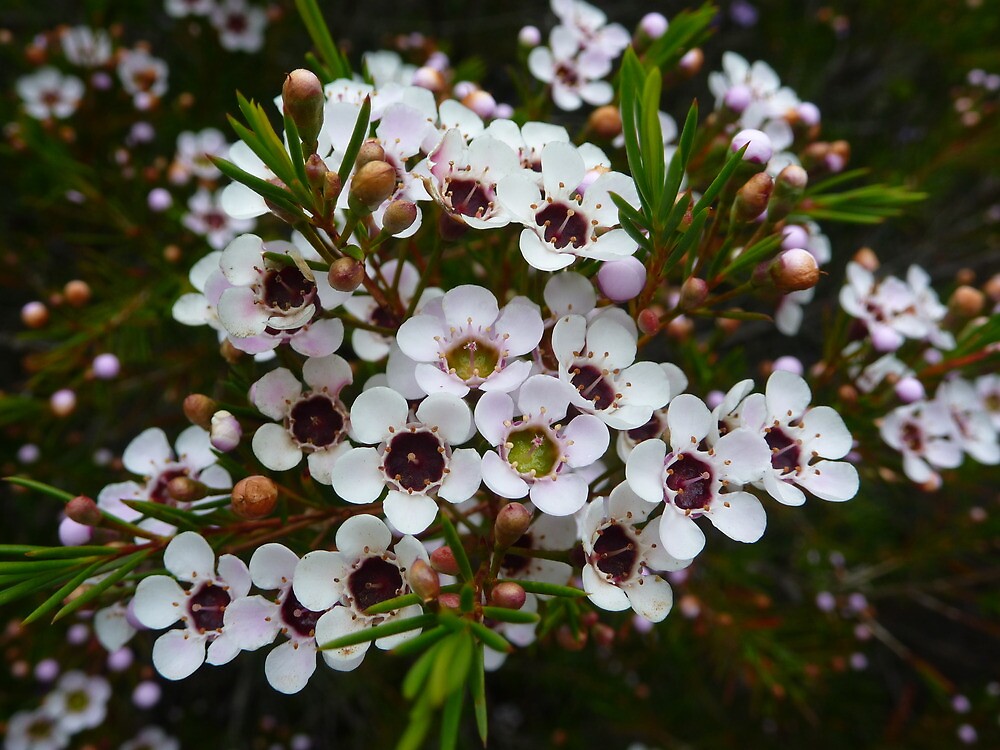
So happy to be able to release a new design today which I have just finished working on and that is of the Geraldton Wax which, as the name suggests, is endemic to Western Australia.  It's a beautiful and hardy medium to large shrub bearing either white, pink or purple blooms and aromatic leaves and can grow to a height of 4 metres which, as you can imagine, would look just spectacular when in flower en masse.  I can only imagine the fragrance too.  This also makes the plant highly attractive to bees and pollinating insects.  The petals have a unique circular shape which are separated from each other and quite robustly formed.  

Image result for geraldton wax white


The Geraldton Wax is a well known Australian native flower and extensively used in the cut flower industry for its beauty and longevity.  Many years ago when I was doing floral work, Geraldton Wax was pretty much the only standard 'fill-in' flower for arrangements and bridal bouquets - as well as Gypsophilia (Baby's Breath).  Sprigs would be used in corsages and buttonholes to complement the bride's and bridesmaid's bouquet.  What I do remember most about working with the flower was its rustic and heady fragrance and the almost woody feel of the stem in comparison to other more fragile flowers. Today native flower bridal bouquets are quite popular and with such an array of beautiful native flora on the market, it's great to see the Geraldton Wax has stood the test of time.


My design is 64 x 76mm (2.5 x 3in) in dimension when using 14/inch fabric or 35 x 42 stitches.  It uses 8 colours and double strands for the stem and needle-like leaves to give the impression of strength and robustness.  Both stem and leaves are stitched using filament threading whereby a single thread of two different shades or colours are threaded in the needle and then stitched together as one.  Small french knots for the centre of the flower and larger and thicker french knots for buds complete the design. 

As with all my designs, instructions are clearly set out on all kits and charts and available now on my website.  In time, this design will be stitched as an item and listed in my Etsy shop.  I feel as though the shape of the design could lend itself quite well as a needlebook and look quite pretty on complementary evenweave and contrasting cotton.  What a great excuse to buy more fabric!!

Ros

'If you love life, life will love you back' - Arthur Rubenstein

Tuesday, 12 January 2016

New Design Release - Mountain Devil


Happy New Year to everyone and welcome to the release of my first design for 2016 - the Mountain Devil flower. 

I agree that the name is unusual and dramatic and perhaps conjures images of witchcraft but rest assured it is derived from the horned woody follicles which retain a seed bank in its canopy and released after bushfires.  What I find so absolutely fascinating with some of our wildflower bushes are their ability to regenerate and re-establish after the heat and intensity of our harsh bushfires. 

This showy flower, consisting of seven individual tubular flowers, has a common name of Honey Flower and produces an abundance of sweet nectar which attracts a variety of native birds, eg. honeyeaters, noisy miners, little wattlebirds and eastern spinebills. The multi-stemmed bush spreads to a height of two metres with stiff, narrow leaves and showy pink to red flowerheads.  It is endemic to New South Wales and found on or to the east of the Great Dividing Range growing in sandy or rocky soils of open forests.


My cross stitch design has depicted the colours of this wildflower by using 11 colours to match as closely as possible to its natural counterpart.  The design uses 39 x 48 stitches and when stitched on 14 point Aida or 28 count evenweave fabric measures 71 x 87mm (2.8 x 3.4 inches).  As with all my designs, it is available in kit, chart or PDF.


A Google search of Australian Bush Flower Essences found an interesting fact for the Mountain Devil flower.  It states that the essence from this flower helps to deal with feelings of hatred, anger, jealousy and the major blocks to expressing love and for people who tend to be suspicious of others by helping to develop unconditional love and acceptance.  It also states that it helps to express anger in a healthy way and develop sound boundaries and may open the way to forgiveness.

Whether you believe is up to you but what a magical flower if found to be the case.  We live in a world today where we certainly could use more love and acceptance of others.

Ros

'From a little spark may burst a mighty flame' - Dante


Saturday, 24 January 2015

New Design Release - Australian Pelican

In conjunction with Australian Day celebrations this weekend, I am delighted to release a new design which is symbolic of our Australian outdoor lifestyle.  Whether swimming at the beach or boating or fishing on or near lakes, the Australian Pelican can be a tranquil sight when spotted gliding on the water early in the morning or at dusk but equally as noisy and displaying flamboyant behavioural patterns when in flocks.   When the country experiences monsoonal rains and flooding of salt lakes in arid inland Australia - which coincidentally is happening at the moment - many pelicans will take advantage of these conditions and flock in their thousands to these locations to breed. 

The Australian Pelican is the largest of eight (8) species of pelicans throughout the world which can live to between 10 and 25 years in the wild.  They are found widespread over the continent and are quite capable of travelling long distances for suitable water, food and breeding grounds which can range anywhere from mudflats to beaches and reefs of inland and coastal waters.  Their diet consists mainly of fish but they will also feed on insects and aquatic crustaceans and sometimes work in groups to drive fish to shallower water.  But probably the most unique feature of the Australian Pelican is its pink elongated bill which is considered to be the longest of any living bird.  It is used as a pouch to collect food and water and has a sharp serrated tip on its beak to grip slippery fish before wedging and holding it into the bill and swallowing.


Recently, just after Christmas my family took a short break to the beach at Bribie Island (about an hours drive north or Brisbane) and as we drove over the iconic wooden bridge spanning the mainland to the island, were greeted by these beautiful creatures sitting atop wooden posts acting almost like sentinels and welcoming us.  It inspired me to get out my sketching pad again and put needle and thread to work.


The cross stitch design has 11 colours and is 49w x 37h (89 x 67mm/3.5 x 2.6in) in dimension.  The light sandy ocean effect has been depicted by using double strand pale blue and pale green thread. 

I was very pleased with how this design stitched up and I'm sure it would appeal to anyone who loves the beach or fishing.  It certainly makes me want to visit Bribie Island again.

Ros

'Remember day by day, to scatter seeds of kindness as you pass along the way' - Ella Wheeler Wilcox


Tuesday, 18 November 2014

'Isn't She Lovely'

This is just one of my favourite Stevie Wonder songs - singing about the joy and happiness and overwhelming love on the birth of his baby girl.  

Fitting for this post, because a couple of weeks ago the son (and his beautiful wife) of one of our neighbours - who we witnessed grow from a highly-spirited and adventurous young boy into a responsible and hardworking man - were blessed with the safe arrival of a daughter. I decided to stitch them a card as a personal gift to welcome the new family member.


The design was from Issue 77 of the Cross Stitch Card Shop magazine and I just used slightly brighter threads from my stash to blend in with the recommended colours so as to appeal to young, modern parents.  Stitched on 14 count white thread, consisting of only full cross stitches and clear-taped onto folded bright pink cardstock, it probably took approximately 3 hours to complete.  I always love the detailing of backstitching as, I believe, it transforms the stitched work into artwork.

Our best wishes to the new family and their future happiness.  

Ros

"A baby is born with a need to be loved - and never outgrows it." - Frank A. Clark


Thursday, 2 October 2014

Design Release - Boronia

October is Breast Cancer Awareness month and so in keeping with the recognised colour of pink associated with breast cancer I thought it appropriate to release a new design - the Boronia.  


Boronias grow as low shrubs in open forests and woodlands and belong to a family of approximately 95 species Australia wide.  The species of Boronia chosen for my particular design - Boronia safrolifera (or commonly known as Safrole Boronia) - grows mostly in south-east Australia in moist soils but can also be found in protected areas of swamp regions of northern New South Wales and southern Queensland.  It has a pretty and dainty star-like shaped flower ranging in colour from deep to pale pink with a beautiful perfume which is harvested for its well-known essential oil qualities and strongly-scented aromatic leaves commonly used in potpourri.  An interesting fact is that the Boronia was named after an 18th century Italian botanist Fransesco Borone.


My cross stitched boronia measures 54 x 78mm (if stitched on 14 point Aida) or 30 stitch width x 43 stitch height dimensions and consists of 9 colours.  Small white and lemon french knots placed in the centre of each open flower complete the design.  Easily and quickly stitched, this design would be beautiful for any floral enthusiast.

Ros

'Nothing is so strong as gentleness, nothing so gentle as real strength' - Francis de Sales