Showing posts with label bush. Show all posts

Tuesday, 12 January 2016

New Design Release - Mountain Devil


Happy New Year to everyone and welcome to the release of my first design for 2016 - the Mountain Devil flower. 

I agree that the name is unusual and dramatic and perhaps conjures images of witchcraft but rest assured it is derived from the horned woody follicles which retain a seed bank in its canopy and released after bushfires.  What I find so absolutely fascinating with some of our wildflower bushes are their ability to regenerate and re-establish after the heat and intensity of our harsh bushfires. 

This showy flower, consisting of seven individual tubular flowers, has a common name of Honey Flower and produces an abundance of sweet nectar which attracts a variety of native birds, eg. honeyeaters, noisy miners, little wattlebirds and eastern spinebills. The multi-stemmed bush spreads to a height of two metres with stiff, narrow leaves and showy pink to red flowerheads.  It is endemic to New South Wales and found on or to the east of the Great Dividing Range growing in sandy or rocky soils of open forests.


My cross stitch design has depicted the colours of this wildflower by using 11 colours to match as closely as possible to its natural counterpart.  The design uses 39 x 48 stitches and when stitched on 14 point Aida or 28 count evenweave fabric measures 71 x 87mm (2.8 x 3.4 inches).  As with all my designs, it is available in kit, chart or PDF.


A Google search of Australian Bush Flower Essences found an interesting fact for the Mountain Devil flower.  It states that the essence from this flower helps to deal with feelings of hatred, anger, jealousy and the major blocks to expressing love and for people who tend to be suspicious of others by helping to develop unconditional love and acceptance.  It also states that it helps to express anger in a healthy way and develop sound boundaries and may open the way to forgiveness.

Whether you believe is up to you but what a magical flower if found to be the case.  We live in a world today where we certainly could use more love and acceptance of others.

Ros

'From a little spark may burst a mighty flame' - Dante


Sunday, 8 November 2015

After The Storm

Serendipity is a wonderful, wonderful thing.  It had been on my mind for a week or so now that I needed to write a new post on my blog and whilst there were topics to speculate on or finished projects that I've worked on to show and share, the right descriptive words just weren't forming. Sometimes I take that as an omen to hold off until a subject presents itself clearly and never has that been so obvious than about half an hour ago ... something that I just had to share with everyone because it excited me so much and not just the topic but the timing. 

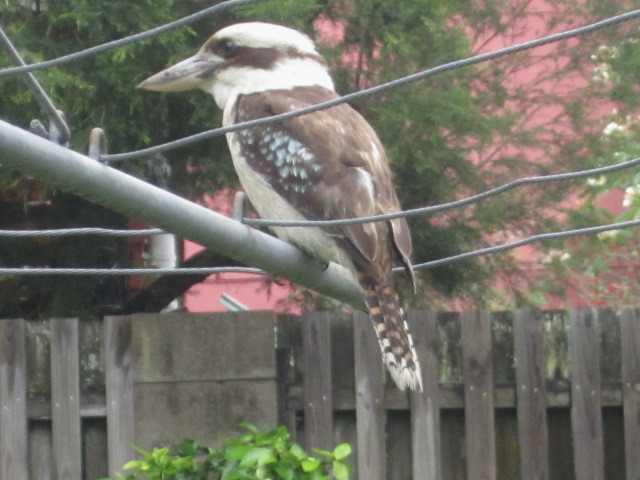
You see here in Brisbane we have entered the summer storm season with us experiencing a severe storm last night and yet another one at lunch time today.  I had eaten my lunch on our back deck overlooking a view of gum trees and bushland, picked up some rubbish to take downstairs and place in the bin with full intentions of then going to my workroom/office to write a new blogpost.  As I opened the screen door to take the rubbish to the bin, I was pleasantly greeted by a kookaburra sitting on our clothesline drying himself off after the storm.  So ... as you do ... I carefully retraced my steps, grabbed the camera and in order not to frighten him away, quietly started snapping photos.


This little fellow knew he was on display and in typical form, tilted his/her head from one side to the other for complimentary angle shots.


It was quite a tame kookaburra because I couldn't believe it when I was allowed to walk behind him/her and take this back view without the kookaburra ruffling even one little feather ... mind you the beady eyes were watching me very closely indeed.  And then while I was admiring the colours and size of this awesome iconic Australian bird, he then spotted a tasty bite to eat somewhere on our grass, flew to it, grabbed it in his powerful beak and flew to the nearby garden shed to swallow it in one giant gulp.

The kookaburra is one of my earlier designs (consisting of 13 colours) which can be found on the website - www.gumleafstitchdesigns.com.au - and for obvious reasons, quite a popular one.  

Although we have regular visits from kookaburras in the area with their reputable laughing call (which some people take to mean a sign of rain), it's not very often one pays us a visit in our backyard and on the clothesline.  Now, just how Aussie is that!!

Ros

'Sometimes serendipity is just intention unmasked' - Elizabeth Berg


Monday, 21 September 2015

Design Release - Numbat

Today I release a new design of a distinctively marked bush animal which admittedly is not very well known about both here in Australia and abroad.  The numbat is a small and colourful creature (between 35 to 45 centimetres or 14 to 18 inches in length) with a long pointed snout, bushy tail about the length of its body and white stripes over its back and rump.  A black stripe also runs over each eye from the base of the ear to its muzzle.  The numbat is sometimes called the banded anteater, marsupial anteater or walpurti and inhabits the natural environment of Western Australia's open woodland eucalypt and jarrah forests.


o

The numbat's diet consists exclusively of termites with an adult requiring as much as 20,000 ants a day for its survival and like many ant-eating animals uses a long and narrow sticky tongue to collect its food from termite mounds.  The interesting fact about this animal is that whilst like all other marsupials it uses its strong sense of smell to hunt for food, it also possesses the highest visual ability of any other marsupial.  Adult numbats are solitary and territorial creatures setting up an area early in life and remaining there after that with the only exception of venturing out in the mating season.  These gentle creatures currently have an endangered status with their predators being foxes, carpet pythons and various falcons, eagles and hawks.


I have to admit that this cross stitch design was a challenge trying to feature the stripes and incorporate all colours and the details that this little fellow has.  Numbats vary in colour combinations from greys to copper so I decided to brighten the design by using the more of the earthy shades.  There are 11 colours in total and measures 98 x 74mm (3.9 x 2.9 inches) when stitched on 14 point aida fabric with stitch dimensions of 54 x 41 stitches.

Australia is indeed home to some very different and unusual animals - I guess it's what helps make us such an interesting nation and I am proud to be able to highlight our uniqueness through my work.

Ros

'We could learn a lot from crayons.  Some are sharp, some are pretty, some are dull, some have weird names and all are different colours...but they all have to learn to live in the same box' - Robert Fulghum


Saturday, 25 May 2013

Snow Flake Bush

Over the last week or two winter has well and truly arrived in Brisbane (even though we are still officially in Autumn) and one of the best things about winter in the tropics is that we have the most glorious of days with minimal rainfall and warming sunshine. Although a lot of trees may lose their leaves during this time, one bush that makes an appearance with a spectacular display - if only for a short time - is the Snow Flake Bush.  They are in full bloom everywhere in our neighbourhood at the moment and so I thought I would feature this flowering bush whilst currently at its most beautiful.  


Originating from Central America, the Euphorbia leucocephala bush is grown in many countries and as such has been given many common names, a couple being 'Snows of Kilimanjaro' and 'Pasquita', but here in Australia we are familiar with the name of 'Snow Flake'.  Closely related to the Poinsettia flower, this bush is a low maintenance shrub growing 1.5 to 2 metres in height and 2 to 3 metres in width in full sun to semi-shade and will suit an average garden, however, it doesn't tolerate frost.  Its best climate is in areas north of Sydney and Perth and mostly dominates the coastal perimeter.


The pretty creamy/white, petal-like bracts are dense blooming and cover the entire plant in fragrant flowers which attract butterflies and flower only during Autumn and Winter (April to July) when the days are shorter and there is the least amount of daily sun.  After flowering, the bush loses its leaves for a short while before again greening up from Spring onwards for the remainder of the year.  The stems contain a milky sap which could irritate some sensitive skins therefore it's advisable to wear protective gloves when pruning or taking cuttings.


All of these above photos were taken in my local street and considering we live in a tropical climate of extreme heat, cyclones and severe electrical storms and don't really experience bitterly cold winters, I find it wonderful to dream of being surrounded by 'snow flakes' even if it is a bush and only for such a short time.

Ros

"Failing to try is far worse than trying and failing" - Bryce Courtenay